
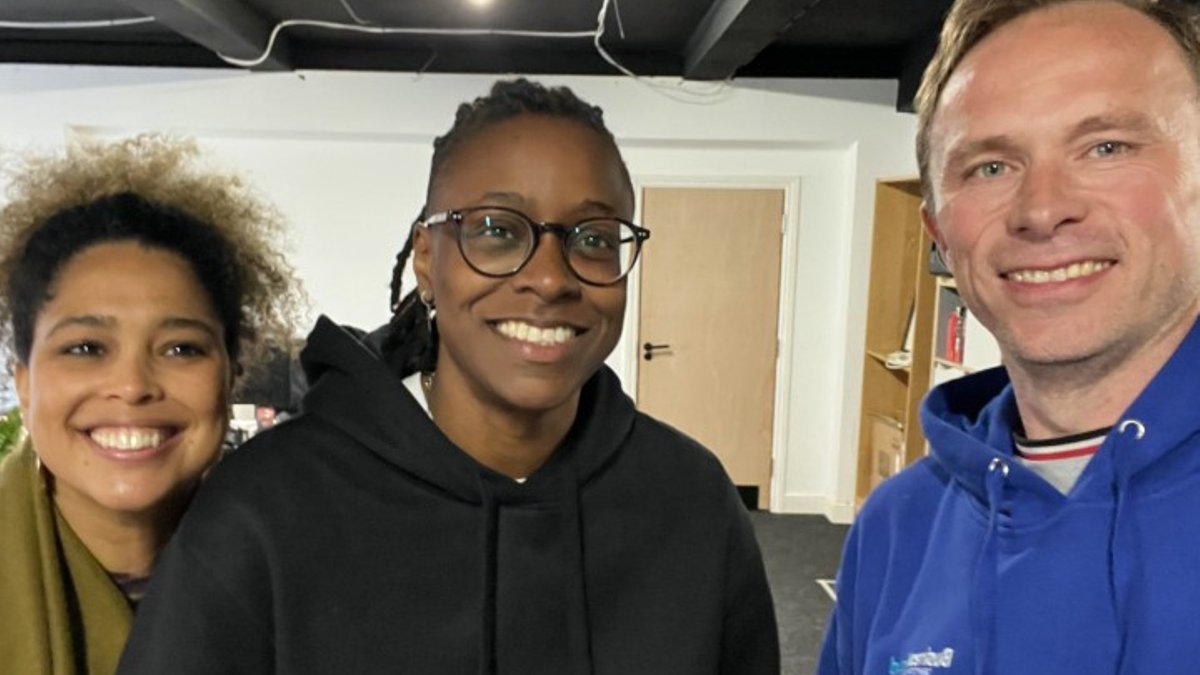
Aiwan Obinyan and Dr. Tamanda Walker did not initially aim to construct a cultural ecosystem. Their original motivation was simply to operate within an industry that did not overlook them.
Obinyan, an audio engineer of Nigerian descent, had spent years working in a music industry that was contracting—studios were closing, internships remained unpaid, and the workplace treated her identity as a Black woman in a predominantly white, male-dominated field as an anomaly. “You’d go on a set, and they’d be like: ‘What are you doing here?’” she recalls. This frustration ultimately led her to establish AiAi Studios in 2013, a production company offering creative autonomy and a space where others like her could thrive.
Read Also: Biotech firm secures £36m to advance ulcerative colitis treatment
Her first opportunity came unexpectedly. While sharing a home in Lewisham with actor Neil Maskell, known for his roles in Utopia and Peaky Blinders, she composed music for his short film, Shitkicker. The film’s credits featured her name, sparking the question: How can I do more of this? Over time, she transitioned from live sound to screen-based work, recording location audio on productions like Coronation Street. Yet the industry’s biases persisted. “Every set you step on to has a white guy in charge. And then here comes me, who’s doing what I do and looks how I do,” she says.
From Sound to Storytelling: Documenting Black Histories
Obinyan’s work soon expanded beyond sound. In 2018, she produced Waxprint, a documentary examining the 200-year history of African wax-print textiles, connecting colonialism, the transatlantic slave trade, and globalization. The film secured a U.S. distribution agreement. Later, she collaborated on The Black Cop, a BAFTA-winning short film exploring racism and homophobia within policing, a project that intersected with Walker’s research.
Walker, a sociologist born in Botswana and raised across the UK, had dedicated years to studying marginalized communities through academic research. However, she identified a critical shortcoming: “We produce really good knowledge about the world, but we write it and share it in a way that’s so boring that nobody would ever want to read it.” Her frustration mirrored Obinyan’s, both were producing meaningful work that failed to reach the audiences who needed it most.
Read Also: Salience Labs secures 125 million dollars funding
Merging Research and Media for Real Impact
They first connected when Walker enrolled in Obinyan’s podcasting course. Their shared goals became immediately clear. “You had done all these films about social issues,” Walker told her. “I was like: ‘I need to come and figure out how to work with this person!’” Together, they launched Roots & Rigour, a research and media organization designed to merge academic rigor with accessible storytelling. Their inaugural project was a video podcast, Rigour & Flow, which addressed identity, race, and systemic inequality.
The studio’s commissions reflect this mission. AiAi has worked with brands and publications prioritizing cultural authenticity, including Nike, GAY Times, Amazon, Channel 4, Audible, and gal-dem. These partnerships extend beyond content creation to redefining whose stories are told. For Obinyan, the transition from music to screen-based work was natural. Recording location audio on sets like Coronation Street allowed her to apply her technical skills in new ways. The contradiction, her qualification for the role yet treatment as an exception, became a core principle of AiAi’s approach: a space where marginalized creators were not merely tolerated but empowered.
Read Also: Olympic medallist secures £4.6m for preventative health startup
Pandemic Reveals Deadly Racial Health Disparities
Walker’s academic background in youth justice and education sharpened her focus on systemic inequities. During the COVID-19 pandemic, her research highlighted severe disparities: Black women in the UK were five times more likely to die during or soon after childbirth than white women, a disparity rooted in systemic racism and medical distrust. Despite these findings, many dismissed them as exaggerated claims rather than documented realities. she asked. The solution became Roots & Rigour, a platform bridging academic research with engaging storytelling.
The inaugural episode addressed the question: Can you be African, Christian, and gay? For Obinyan, who had been estranged from her fundamentalist Pentecostal family over her sexuality, the question was both a personal challenge to rigid systems and a call for greater visibility. Subsequent seasons covered topics such as the UK’s proposed social media ban for children, the ethical concerns of family vlogging as potential child labor, and the intersections of charity, race, and class. Each episode challenged assumptions, such as who defines “charity” and who benefits from it, while centering voices typically excluded from such discussions.


